What Sunscreen Can I Use In The Galapagos Islands?
The Galapagos park restricts sunscreens containing oxybenzone and octinoxate during water activities, and many boats ban aerosols on deck. Here is what actually passes, and where to buy it before you fly.
 By Oleg Galeev, Editor
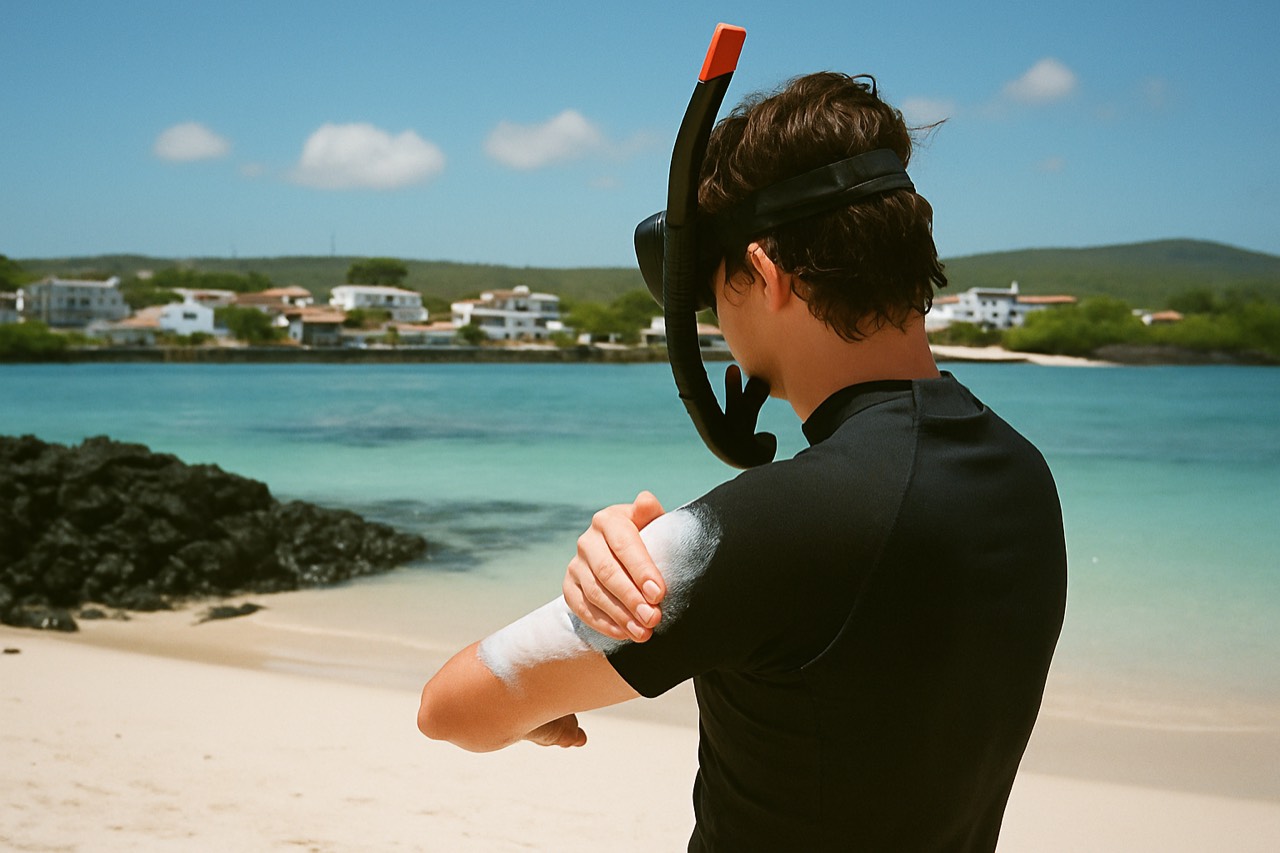
What Sunscreen Can I Use In The Galapagos Islands?
Use a mineral sunscreen whose only active ingredients are zinc oxide or titanium dioxide, in a lotion or stick rather than an aerosol, bought before you reach the islands. The Galapagos National Park restricts sunscreens containing oxybenzone or octinoxate during water activities in the protected areas, and many vessels additionally ban spray sunscreens on deck because they blow across other guests and into the sea. Non-nano mineral lotion passes both rules.
The Galapagos Islands sit almost exactly on the equator, roughly 1,000 km off the South American coast, which changes the sun protection maths in a way most travellers underestimate. The sun is close to directly overhead at midday all year, there is very little haze in the dry season to soften it, and a typical package day involves two or three hours of it: a panga ride, a snorkel session, a walk over black lava that reflects heat and light back up at you. The ultraviolet exposure at these latitudes is not a rounding error on what a European or North American beach holiday delivers. It is a different category.
The rules are the second half of the question. The instrument that governs visitor behaviour in the park and the marine reserve is Resolución MAE-PNG/DIR-2026-0044-RM, signed by the park directorate on 12 August 2026 and published in the Registro Oficial, and its article 4.19 restricts sunscreen products containing oxybenzone or octinoxate during water activities in the protected areas. That is a park rule, not a suggestion from a cruise line. The same resolution sets the two-metre minimum distance from wildlife while snorkelling and the visiting hours at the authorised sites, so sunscreen sits in the same body of rules as the behaviour every guide will brief you on anyway.
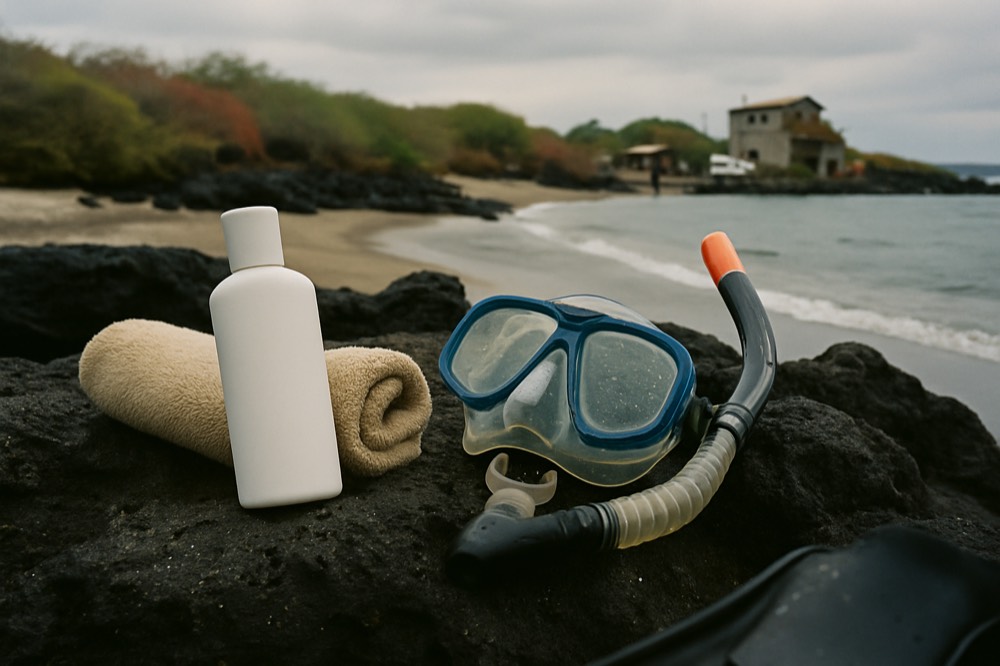
Practically, this means the bottle you toss in your bag at home matters more than the one you hope to buy in Puerto Ayora. The inhabited towns have pharmacies and small shops, but the selection of genuinely reef-compliant mineral sunscreen is thin, the price is high, and if your package starts the morning after you land, you may be applying whatever you could find at Quito airport. Buy it before you fly, check the active ingredients on the back label rather than the "reef safe" claim on the front, and pack it in your carry-on so a delayed bag does not leave you unprotected.
If you are still choosing the shape of your trip, a land-based package keeps you near shops and pharmacies between excursion days, while a cruise keeps you on the water for the whole run. These three packages span that choice:
Which Ingredients Are Restricted In Galapagos Waters?
Two chemical filters are restricted by the park during water activities: oxybenzone (also labelled benzophenone-3) and octinoxate (octyl methoxycinnamate or ethylhexyl methoxycinnamate). Both are common in mainstream chemical sunscreens. Mineral filters, zinc oxide and titanium dioxide, are not on the restricted list, and non-nano versions of those two are what most operators now recommend you bring.
The restriction is written into the general visit rules for the Galapagos National Park and the Galapagos Marine Reserve. Article 4.19 of Resolución MAE-PNG/DIR-2026-0044-RM restricts products containing oxybenzone or octinoxate during water activities in the protected areas, which in practice means every snorkel stop, every kayak session and every panga ride your package includes. The marine reserve you are swimming in is one of the largest in the world, 133,000 km², extended from its original 70,000 km² in 1998, and the park treats what washes off your skin as part of managing it.
The reason these two filters get named, in Galapagos as in Hawaii and Palau, is that both are lipophilic, they accumulate in living tissue rather than dissolving away, and laboratory studies have linked them to coral bleaching and to hormone disruption in marine organisms. A single swimmer sheds a small amount; several hundred visitors a day at a popular snorkel site, repeated across a year of 290,404 arrivals, is not a small amount. The park's answer is to restrict the two most-studied offenders at the point of use rather than attempt to police every bottle at every dock.
| Label wording you might see | What it usually means | Passes the Galapagos water-activity rule? |
|---|---|---|
| Oxybenzone, benzophenone-3 | Chemical UV absorber, very common in US drugstore lotions | No, restricted during water activities |
| Octinoxate, ethylhexyl methoxycinnamate | Chemical UVB filter, often paired with oxybenzone | No, restricted during water activities |
| Avobenzone, homosalate, octocrylene | Other chemical filters, not named in the restriction | Legal, but not what most operators recommend |
| Zinc oxide (non-nano) | Mineral blocker, sits on the skin surface | Yes, the safest choice |
| Titanium dioxide (non-nano) | Mineral blocker, often combined with zinc | Yes |
| "Reef safe", "reef friendly", no other detail | Unregulated marketing term, no legal definition anywhere | Check the active ingredients, ignore the claim |
The last row is the one that catches people. "Reef safe" is not a certification; any brand can print it. The US FDA does not define it, Ecuador does not define it, and a bottle can carry the words while listing oxybenzone third in the ingredients. The only reliable test is the active ingredients panel on the back, which in the United States and Canada lists filters by name and percentage. If zinc oxide or titanium dioxide is the only active, you are compliant with the park rule no matter what the front of the bottle claims or fails to claim.
One more thing worth knowing: the restriction covers water activities specifically, and the park's biosecurity agency separately controls what you may bring into the islands at all. The ABG, the Galapagos biosecurity agency, inspects baggage at Quito and Guayaquil airports before check-in and again on arrival, and its regulated products list is colour-coded by risk. Sealed cosmetics and toiletries are not a problem, but this is the same inspection that confiscates fresh fruit, so do not tuck sunscreen into a bag with snacks you planned for the flight.
What Does Reef-Safe Actually Mean On A Label?
Nothing, legally. "Reef safe" and "reef friendly" are marketing phrases with no regulatory definition in the United States, Ecuador or anywhere else, and a bottle can carry them while containing oxybenzone. The only part of the label that matters is the active ingredients list. If it names zinc oxide or titanium dioxide and nothing else, the product matches what the Galapagos restriction and most operators are asking for.
The gap between the claim and the contents is well documented in the sun-care industry. Surveys of "reef friendly" labelled sunscreens sold in the United States have repeatedly found chemical filters in the ingredients, because the phrase is self-declared. Hawaii's 2021 law, which banned the sale of sunscreens containing oxybenzone and octinoxate, did not create a "reef safe" certification either; it simply removed the two named filters from store shelves. Galapagos has taken the same naming approach, which is why reading the filter names is the whole exercise.
"Non-nano" is the second term you will meet on mineral sunscreen labels. It refers to particle size: zinc oxide and titanium dioxide ground small enough to rub in clear are "nano", while larger particles that leave a faint white cast are "non-nano". The concern with nano particles is that they may be ingested or absorbed by marine organisms, so the precautionary recommendation from marine researchers and from most Galapagos operators is non-nano mineral. The trade-off is cosmetic. Non-nano zinc leaves a whitish film, which some people dislike, though on a snorkelling trip a slight white cast is a small price for compliance and for the fact that mineral blockers work the moment you apply them, no 15-minute wait for chemical absorption.
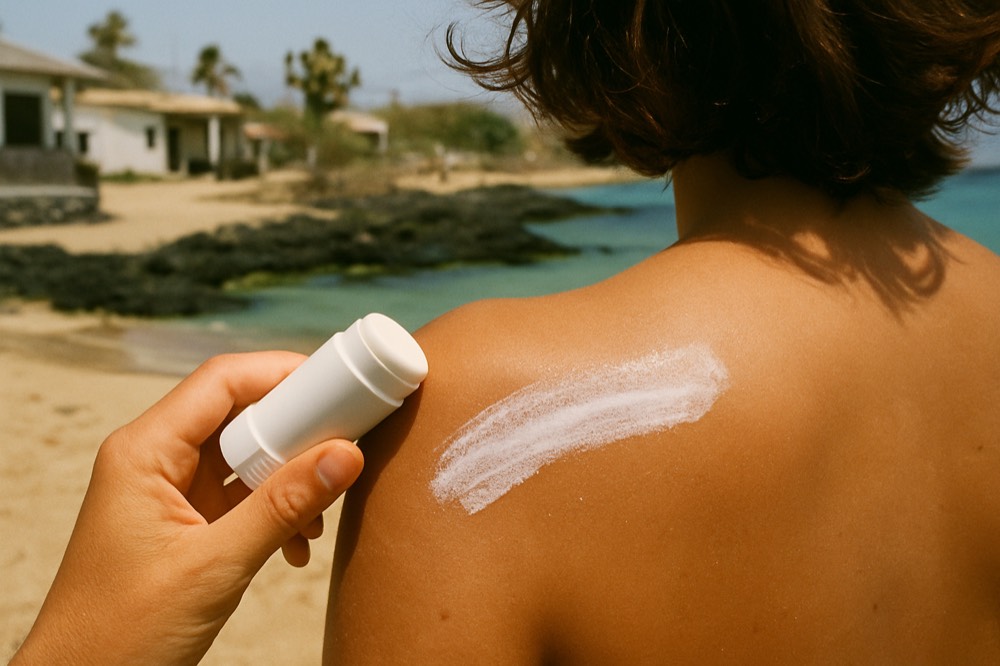
A short shopping method, if you want one. Turn the bottle over. Find "Active Ingredients". If you read Zinc Oxide and Titanium Dioxide and nothing chemical-sounding, buy it, ideally SPF 50, water resistant, lotion or stick format. If you read anything ending in "-one", "-ate" or "-crylene", put it back. That single rule catches the overwhelming majority of cases, and it takes ten seconds in any pharmacy.
Why Do Boats Ban Aerosol Sunscreen On Deck?
Because aerosol clouds do not stay on the person spraying them. On a moving vessel the mist blows across other passengers, into eyes and mouths, and a large fraction of the product misses the skin entirely and lands in the sea. Many Galapagos expedition boats now ask for lotions and sticks only, a house rule that sits on top of the park's ingredient restriction.
The physics is straightforward. Spray sunscreens are designed to deliver a fine mist over a wide area, which is exactly what you do not want in a breeze on an open deck. Studies of aerosol application have found that a substantial share of the product never reaches the target skin, and on a boat that share goes overboard. Add the deck layout of a small expedition vessel, where sixteen to twenty guests share a confined outdoor space, and one person's spray becomes everyone's exposure. Crews also report the slick it leaves on railings and decking, a slip hazard on a wet deck.
This is a vessel rule rather than a park regulation, so it varies by operator, but the direction of travel is one-way: more boats adopting it, none dropping it. The safe assumption, whichever package you book, is that your sunscreen should be a lotion in a squeeze bottle or a solid stick. Sticks are especially good for faces and for reapplication over sunscreen already on, they cannot leak in a dry bag, and they count as a solid rather than a liquid for security screening, which matters if your Galapagos itinerary includes a light aircraft leg.
The reapplication habit matters as much as the format. Guides on water-heavy days will typically call for sunscreen at a set point before a snorkel, because the park rule pushes everyone to apply before entering the water rather than floating in the shallows with a bottle. A lotion you can apply quickly on a moving panga, or a stick you can run over your face without a mirror, gets reapplied. A product that is unpleasant to use gets skipped, and at the equator a skipped reapplication is a burn by dinner.
Where Should You Buy Sunscreen Before You Fly?
Buy it at home, or at a mainland Ecuador pharmacy in Quito or Guayaquil the day before your flight. The inhabited Galapagos towns do sell sunscreen, but the compliant mineral selection is limited and expensive, and a package that starts with a morning excursion leaves no shopping window. Arrive with the bottle already in your bag.
The logistics of the islands explain the advice. Four of the archipelago's 127 islands, islets and rocks are inhabited, and the shops are concentrated in Puerto Ayora on Santa Cruz and Puerto Baquerizo Moreno on San Cristobal. They stock basic sunscreens, and increasingly they stock mineral options because demand has grown, but the range is small, the price reflects the cost of shipping everything 1,000 km out into the Pacific, and you are choosing between whatever two or three bottles happen to be on the shelf. Mainland Ecuador, by contrast, has full urban pharmacies in both gateway cities, and your package almost certainly routes you through one of them.
The timing point matters more than people expect. Flights from Quito and Guayaquil land at Baltra or San Cristobal in the morning, and the park's own arrival guidance is to be at the mainland airport three hours before departure, because of the biosecurity inspection and the transit control card process. If your package includes a hotel pickup and an excursion on day one, the realistic shopping window on the islands is the evening of your first full day at the earliest. That is a day of equatorial sun spent under whatever you brought.
| Where to buy | Realistic selection of non-nano mineral SPF 50 | Price level | When you can realistically shop |
|---|---|---|---|
| Home, before you travel | Full, you can read labels calmly | Lowest | Any time before departure |
| Quito or Guayaquil pharmacy | Good, major chains stock mineral ranges | Moderate | The day before your flight, not the morning of |
| Quito or Guayaquil airport shop | Limited, travel sizes, marked up | High | Only if you have a long layover |
| Puerto Ayora or Puerto Baquerizo shops | Small, a few brands, sell out in peak season | High | Evening of day one at the earliest |
| On a cruise vessel | Whatever the ship's small shop holds, if it holds any | Highest | Mid-trip, too late for the first snorkels |
One genuinely useful pattern for Galapagos specifically: pack two products rather than one. A lotion for the body, applied once in the morning and again at lunch, and a stick for the face and ears, reapplied before every water session without needing a mirror or a bathroom. The stick lives in the dry bag with your mask; the lotion lives in the hotel room or cabin. People who bring only a big lotion bottle tend not to reapply on the water, and people who bring only a stick tend to run out by day three.
The same packing logic applies to your whole kit, and it interacts with the biosecurity inspection described above: sealed, new products raise no questions, while loose food does. The general packing question for a Galapagos trip, beyond sunscreen, is covered in detail in our guide to what to pack for a Galapagos cruise, and the things that cause trouble at the inspection point are listed in our piece on what not to bring to Galapagos.
How Much Sun Protection Do You Actually Need At The Equator?
Plan for SPF 50 applied twice as often as you think, plus a hat, a rash guard and sunglasses. The Galapagos climate is equatorial with two seasons, hot from January to May and cool and overcast from June to December, and the overcast is deceptive: the garúa cloud layer that defines the cool season does little to block ultraviolet radiation, and the sea temperature only drops to about 21.5 °C, so nobody leaves the water early.
The two Galapagos seasons, as defined by the Charles Darwin Foundation's climatology database, are not a wet and dry season in the tropical-holiday sense. The hot season, January to May, brings warmer sea and air temperatures and convective rain. The cool season, June to December, is when the southeasterly trades strengthen, the cold Humboldt influence returns, and a persistent shallow cloud layer with drizzle sits on the windward highlands. That cloud is thin, and the ultraviolet index underneath it stays high. Travellers burn in the cool season precisely because the grey sky makes them skip sunscreen.
The water is part of the story. Sea temperature at Puerto Ayora averages 25.7 °C in March and 21.5 °C in August and September, on 1991 to 2020 means, and air maxima run from about 31 °C in March down to about 24 °C in August. In the warm months the water is bath-like and people snorkel for an hour or more; in the cool months a wetsuit, which many operators rent, extends sessions the same way. Either way, the exposure clock runs longer than on a beach holiday where a swim lasts ten minutes.
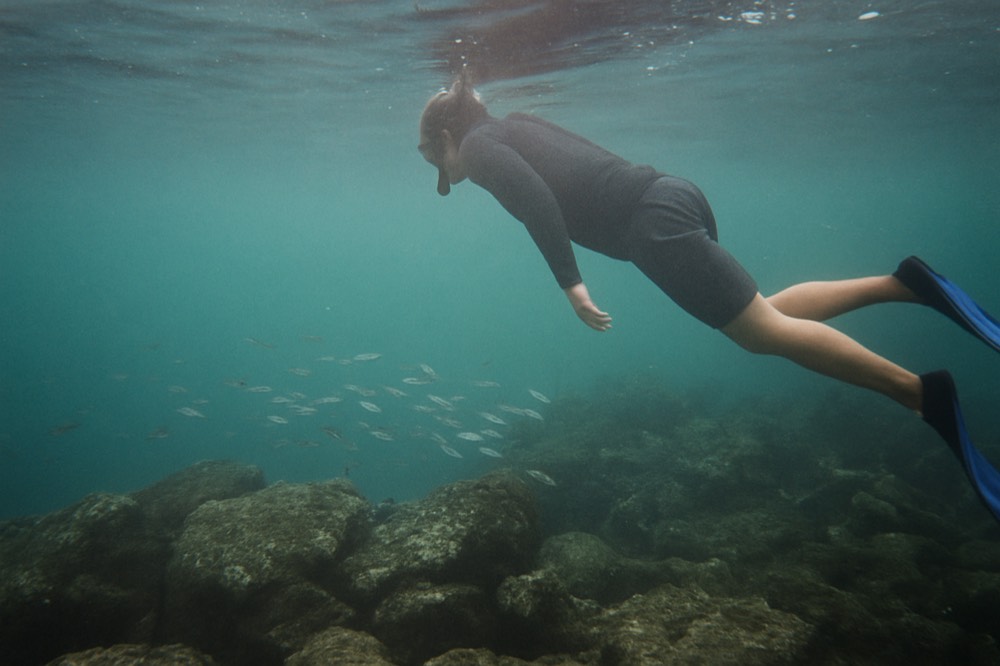
Clothing is the underrated half of the answer. A dark, snug rash guard blocks ultraviolet entirely, needs no reapplication, cannot wash off into the marine reserve, and is standard kit on most multi-day packages anyway because it also protects against stings from the sun-coral hydroids at some sites. A wide-brim hat with a chin strap, because the wind on a panga will take an unsecured one within minutes, covers the scalp and ears that sunscreen misses. Sunglasses matter on the water, where glare doubles the effective exposure to your eyes.
Add the reflection factors and the case closes itself. Black lava reflects heat and light upward, so a walk at a terrestrial visitor site bakes you from below as well as above, and the sea surface does the same on every crossing. The park's visiting hours run from 06h00 to 18h00, and most itineraries put guests ashore in the morning and again in the mid to late afternoon, bracketing the solar peak rather than sitting in it, but the total daily dose is still far above what a temperate-latitude traveller is used to. SPF 50 lotion, a stick for the face, a rash guard for the water and a hat for everything else is the standard, not the cautious option.
What Else Counts As Sun Protection On A Galapagos Trip?
A rash guard or swim leggings, a brimmed hat with a strap, polarised sunglasses, and a conscious choice of shade during the midday hours all reduce how much sunscreen you need in the first place. On a multi-day package the itinerary does much of this scheduling for you, with landings in the morning and afternoon, which is one quiet advantage of a guided structure over piecing days together yourself.
The rash guard deserves its own paragraph because it solves three problems at once. It blocks the sun with zero reapplication, it protects your back and shoulders during long snorkels over reflective sand and rock, and it removes the question of what washes off your skin into the reserve entirely for the largest area of your body. On a five-day or eight-day package with daily water sessions, a traveller in a rash guard applies sunscreen to maybe a quarter of the skin area of a traveller in a bikini, which means less product consumed, less bought, less carried, and less in the water.
Timing is the second lever. The park's authorised visitor sites have defined permitted activities and set hours, and guided groups move through them on a schedule that typically avoids the solar peak. If you are on a land-based package with free afternoons, the standard local rhythm is to do the town, the beach or the shaded highlands in the early afternoon and save open-sun activity for after 15h00. That rhythm is not a cultural accident; it is how people who live on the equator manage the sun.
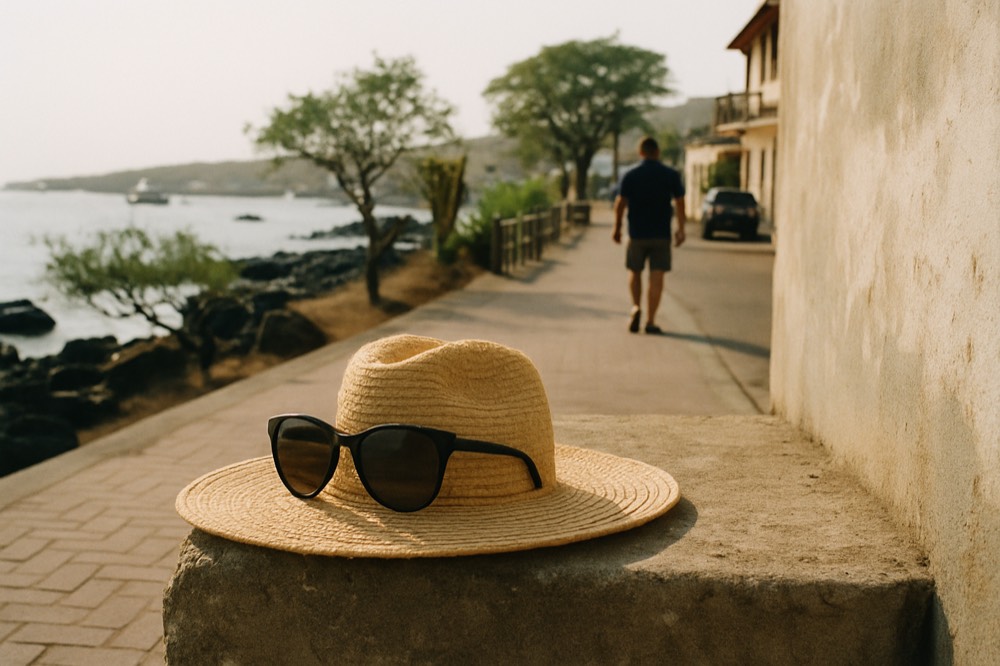
Package structure quietly helps here too. A package with hotel pickup, confirmed excursions and a guide coordinating the day removes the improvisation that leads to sun mistakes: nobody ends up standing in an open boat for two unplanned hours at noon. The 4 or 5-Day Islands Explorer Package from Santa Cruz Island, from $1043 per person, rates 3.8 across 19 reviews and runs small-group days from a Santa Cruz base, which is the format that makes shade, shops and a room to retreat to part of the day rather than a luxury. Check availability if that base-first shape suits you, and see our guide to Galapagos island hopping packages for how the format compares.
At the other end of the style and price range, a cruise itinerary compresses the same protection into a different rhythm. The 7-Day La Pinta cruise, from $8066 per person, rates 5.0 across 48 reviews and runs a fixed route through Santa Cruz, Isabela, Floreana, Fernandina and Rábida; on board, the crew manages the schedule and the ship provides shaded deck space between landings. The fixed itinerary is worth understanding before you book anything in Galapagos: park rules mean a vessel's route genuinely cannot be shuffled on the day, so the sun exposure pattern of your week is knowable in advance.
Whatever the shape, the sunscreen answer stays the same. Non-nano zinc or titanium lotion, a stick for the face, no aerosol, bought before you fly, applied before every water session. It satisfies the park rule, the boat rule and the equator at once, and it is one of the few pieces of Galapagos planning that costs almost nothing to get exactly right. For a fuller treatment of the whole kit, from wetsuits to footwear, start with our Galapagos Islands Tour Packages planning pages and the packing guide linked above.
Common Questions About Sunscreen In The Galapagos Islands
What Sunscreen Can I Use In The Galapagos Islands?
A non-nano mineral sunscreen whose only active ingredients are zinc oxide or titanium dioxide, in lotion or stick form. The park restricts oxybenzone and octinoxate during water activities, and most boats also ban aerosol sprays on deck. Buy it before you fly rather than counting on island shops.
Is Sunscreen Banned In The Galapagos?
No. Sunscreen itself is not banned anywhere in the islands. The park's visit rules restrict two specific chemical filters, oxybenzone and octinoxate, during water activities in the protected areas, and individual vessels may have their own house rules, most commonly against aerosol sprays on deck. Mineral sunscreens are welcome.
Do I Need To Bring My Own Sunscreen Or Can I Buy It There?
Bring your own. Puerto Ayora and Puerto Baquerizo Moreno sell sunscreen, but the compliant mineral selection is small and expensive, and a package that starts with a morning excursion leaves no time to shop before your first water session. Mainland pharmacies in Quito and Guayaquil are a workable backup the day before your flight.
What Does "Reef Safe" On A Sunscreen Label Actually Guarantee?
Nothing. It is an unregulated marketing term with no legal definition in the United States, Ecuador or elsewhere, and products carrying the claim have been found to contain oxybenzone. The only reliable check is the active ingredients list on the back of the bottle: zinc oxide or titanium dioxide only.
Why Do Galapagos Boats Not Allow Spray Sunscreen?
Aerosol mist blows across other passengers and a significant fraction of the product misses the skin entirely, landing on the deck and in the sea. On a small vessel shared by a dozen-plus guests, one spray affects everyone. Lotions and sticks deliver the product where it is meant to go.
Is The Equatorial Sun In Galapagos Really Stronger Than At Home?
Yes, substantially. The islands sit almost on the equator with the sun near overhead at midday year round, and the cool season's overcast garúa layer blocks little ultraviolet radiation. Sea temperatures that only drop to about 21.5 °C mean long snorkels in every month, so total exposure is high even on grey days.