What Language Do They Speak In The Galapagos Islands?
Spanish is the official language of the Galapagos Islands, but guided tours run in English too. A practical look at where English works, where it thins out, and what to learn before you go.
 By Oleg Galeev, Editor
What Language Do They Speak In The Galapagos Islands?
The Galapagos Islands are part of Ecuador, and the official language is Spanish, spoken by the resident population living across the four inhabited islands of the archipelago. On the guided side of a trip, English is a working second language: licensed naturalist guides, cruise crews and tour operators serve an international market in which the United States alone supplied 29 percent of all 2025 arrivals, about 83,000 visitors.
That single statistic explains most of what you will experience. The Galapagos tourist economy is built around foreign visitors, and the largest single group of them is American, with British, Canadian, German and Australian travellers close behind. The Dirección del Parque Nacional Galápagos, which publishes the annual visitor report those figures come from, counts 178,737 foreign arrivals in 2025 against 111,667 Ecuadorian ones. A market that is 62 percent international produces an industry that speaks English on the clock, even though the town around it speaks Spanish.
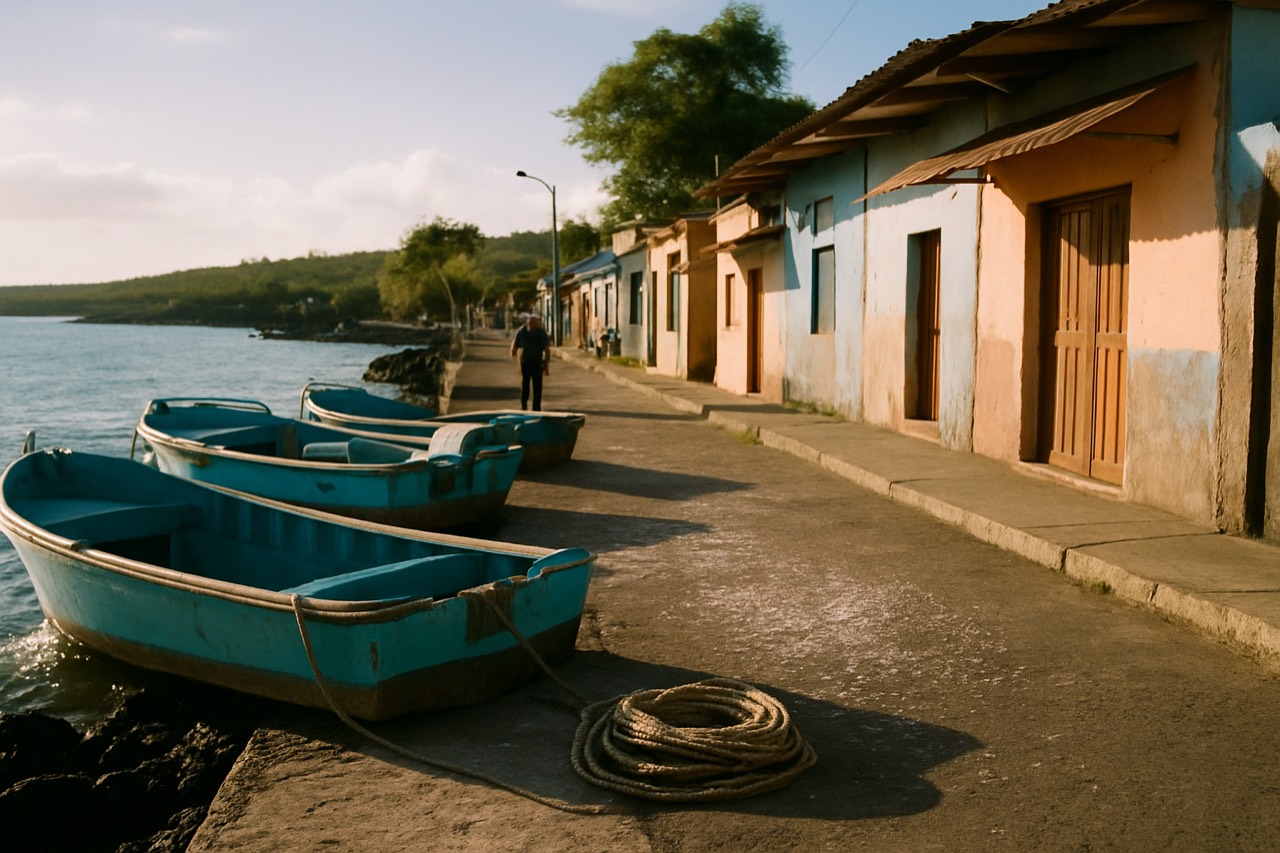
The distinction that matters for a package buyer is not island by island but setting by setting. On a licensed tour, at a visitor site, on a cruise vessel or in a guided day excursion, the working language is whatever the group needs it to be, and for most booked groups that means English or bilingual delivery. In Puerto Ayora's fish market, in a Puerto Baquerizo Moreno hardware shop, at a taxi stand in Puerto Villamil, the language is Spanish, full stop. Nobody in those settings is being unfriendly if the conversation stalls; they are simply at work in their own language.
There is also a practical middle layer worth knowing about. Ecuador's official currency is the US dollar, quoted directly on every Galapagos government fee page, so money is never a language barrier for American visitors. Menus in tourist restaurants often carry English translations. Hotel front desks in the tourist zones handle check-in in English. The friction, when it appears, is in the unplanned moments: a bus driver's announcement, a ferry departure gate, a pharmacy, a conversation with a fisherman whose boat you have just photographed.
If you are weighing how much the language question should shape your booking decision, the short version is that a guided package largely removes it, while independent travel leaves you operating in Spanish a meaningful share of the time. The Galapagos Islands Tour Packages roster is built around guided products precisely because the guide is the person who translates not just words but the park's rules, and the rules are strict: a DPNG-accredited naturalist guide is compulsory at protected sites under the visit rules in force since 12 August 2026.
The land-based share of the market shapes where each language actually reaches you. Because 79 percent of visitors stay on land rather than aboard a vessel, most travellers split their day between two language worlds: an English-language guided excursion to a protected site in the morning, then a Spanish-speaking town in the afternoon. Cruise passengers, by contrast, can spend an entire week inside the English-language bubble of the vessel and its expedition staff, emerging only at visitor sites where the guide is compulsory anyway. If your priority is to hear and use some Spanish, land-based travel hands you that opportunity daily; if your priority is to never worry about it, a cruise minimises the unplanned moments where the language gap appears.
The bilingual guide requirement also means the quality of your English experience depends less on which island you visit and more on which operator you book. The same DPNG-accredited guide who delivers a briefing in English to one group may deliver it in Spanish to the next, so group composition matters. Travellers from the United States, who made up 47 percent of the international market in 2025, will find English-language delivery easiest to secure on international-market products, while domestically oriented departures may run primarily in Spanish even when a bilingual guide is aboard.
A few practical habits close most of the remaining gap. Since prices are quoted in US dollars on the official fee pages, you can handle park fees, transit cards and taxes without a single Spanish word. For the unplanned moments, a handful of phrases covers the vast majority of daily transactions in Puerto Ayora, Puerto Baquerizo Moreno and Puerto Villamil, and residents of the four inhabited islands are used to visitors who speak no Spanish at all. Between the dollar, the translated menus, the English-speaking front desks and the compulsory guide at every protected site, the language question is, for most package travellers, already answered before they land.
Do Galapagos Guides And Tour Crews Speak English?
Yes, working English is standard among licensed naturalist guides, and it is effectively guaranteed on the international cruise and island-hopping products sold to foreign visitors. Guides are trained and licensed by the park directorate itself, which runs scientific briefings to build their interpretive skills, and the guide requirement is written into the current visit rules. Crew English varies more than guide English, and hotel staff in town varies most of all.
The licensing system is the reason guide English is reliable. Naturalist guides in the Galapagos are not freelancers with a microphone; they are accredited by the Dirección del Parque Nacional Galápagos, and the park polices guides and tour leaders at visitor sites. A guide who cannot deliver a briefing to an English-speaking group does not stay employable in a market where Americans alone are nearly half the international arrivals. The park's own materials describe periodic scientific training sessions for guides, which tells you the interpretive layer, the part that makes a walk at Punta Suarez more than a walk, is a professional skill rather than a hobby.
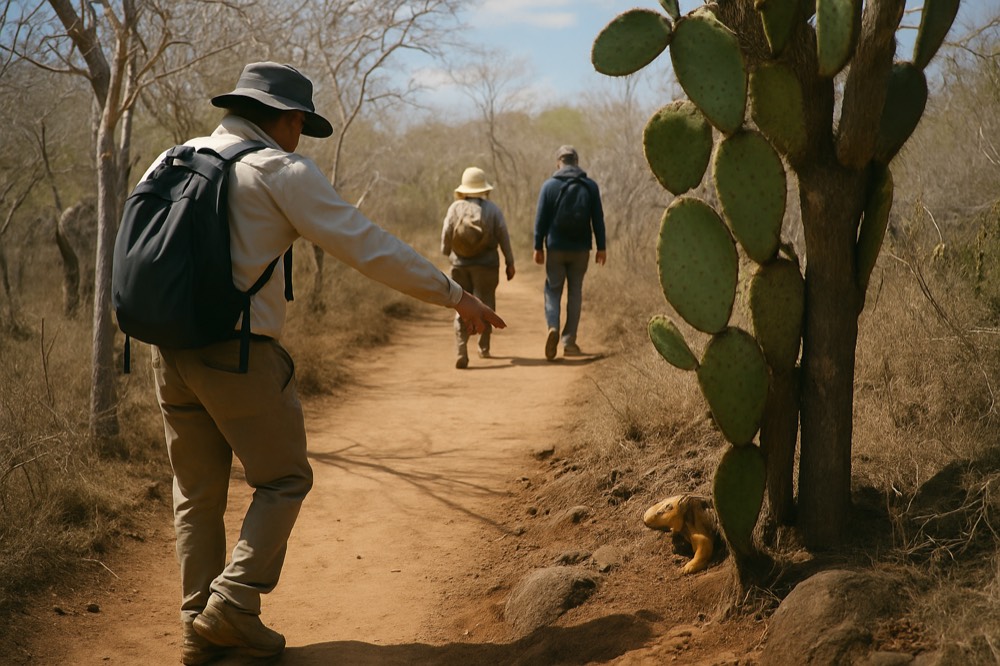
Where the gradient shows up is in the supporting cast. On a small cruise vessel, the naturalist guide will brief in English and often in Spanish too if the group is mixed, but a cabin steward, a cook or a panga driver may have limited English. This rarely causes problems, because the operational moments, meal times, boarding calls, snorkel stops, are announced by the guide. On land-based packages the same pattern holds: the tour day runs in English, the evening in town runs in whatever you can manage.
The 8-Day Island Hopping package is a good illustration of the format. It moves across San Cristobal, Santa Cruz, Isabela, Santa Fe, North Seymour and Baltra with a guide throughout, breakfast and lunch included, from $1829 per person, and rates 4.6 across 7 reviews. That style of product, hotel nights plus guided days, is where the language question answers itself: the guided portion is bilingual by default, and the free evenings in Puerto Ayora or Puerto Villamil are where a few Spanish phrases earn their keep.
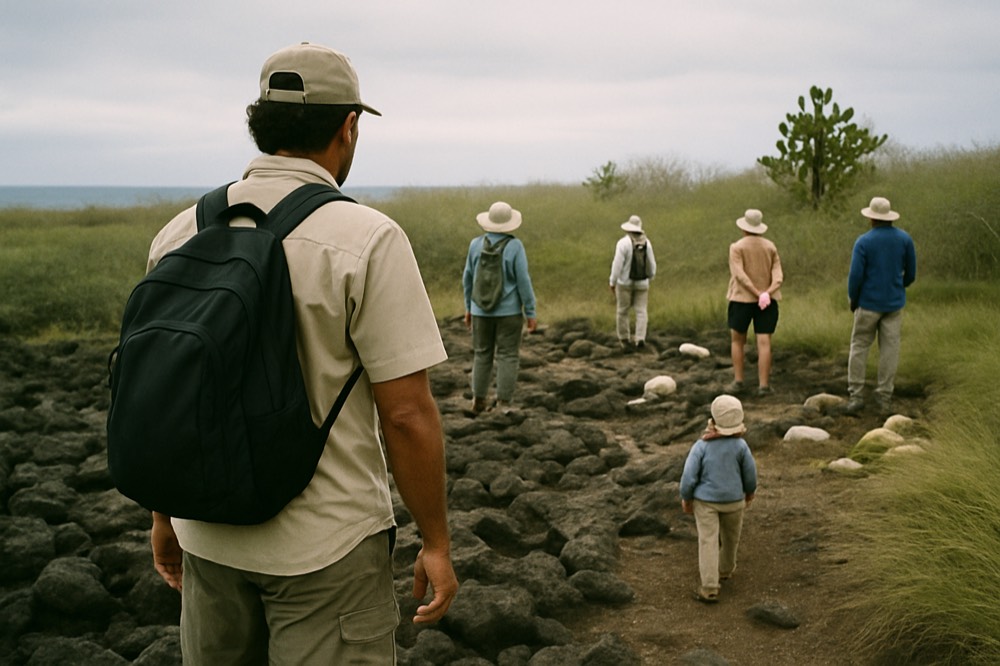
One point worth adding about the guided format: the guide's language role is not only translation but compliance. The visit rules in force since August 2026 set a two-metre minimum distance from wildlife on land and in the water, four metres from shore during kayaking and panga rides, and specific limits around whales and dolphins. A guide who can explain those rules in your language is the difference between a smooth landing and a corrected one, and it is a quiet argument for booking guided rather than going solo.
Where Does English Thin Out In The Galapagos?
English thins out on the town side, not the guided side. The places where a monolingual English speaker will feel it are the inter-island ferries, local taxis, small shops and markets, pharmacies, and administrative moments such as the airport biosecurity and transit-control desks, where staff deal with you in Spanish first and English on request. Roughly a fifth of your practical interactions on a land-based trip may involve little or no English.
The ferry between Santa Cruz and Isabela is the classic example, and it is also the interaction travellers report finding rough in every sense. Departure gates, luggage tagging and boarding calls on the public inter-island speedboats run in Spanish. Nothing about this is hostile; it is simply a domestic service that locals use daily. The same applies to the public bus from the Itabaca Channel to Puerto Ayora, which the park's own arrival page describes, with its roughly US $2 fare, and to the shared pickup taxis at about US $25 per vehicle.
The administrative layer is worth preparing for specifically, because it happens at the start of the trip when you are tired. At Quito or Guayaquil airport you pass through the biosecurity inspection run by the Agencia de Regulación y Control de la Bioseguridad y Cuarentena para Galápagos, and you buy the US $20 Transit Control Card at the CGREG counter before check-in. Staff at both will manage with English-speaking travellers, but signage is in Spanish and the sworn goods declaration is a Spanish-language form. Arriving the recommended three hours early gives you slack for exactly this kind of slow, bilingual moment.
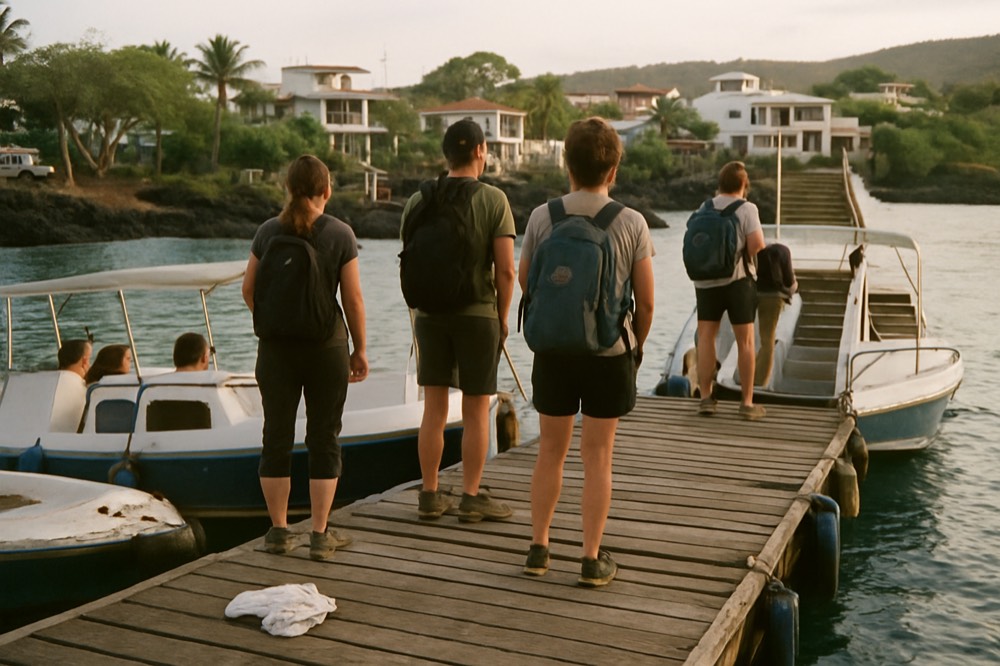
Here is where the gradient is steepest, drawn from the settings a package buyer actually moves through:
| Setting | What language to expect | How much English you need |
|---|---|---|
| Cruise vessel and guided day tours | Guide briefs in English, often bilingual for mixed groups | None |
| Visitor sites in the national park | Guide-led, matches your group | None |
| Hotel front desk, tourist restaurants | Spanish first, English available | Minimal |
| Inter-island ferries, public buses, taxis | Spanish only in practice | A few phrases help |
| Airport biosecurity, transit card counter, park fee payment | Spanish signage, staff assist in English on request | Patience more than fluency |
| Shops, markets, pharmacies, neighbourhoods | Spanish | Basic phrases |
None of this should scare anyone off independent exploring. Residents of the tourist towns are used to visitors, and the dollar economy means prices are legible without translation. But a traveller who books a fully guided package and a traveller who pieces together ferries and day boats on their own have measurably different language experiences, a distinction worth weighing alongside the cost questions covered in how much a Galapagos trip costs.
What About The Cruise Side Of A Package?
On cruise products, English coverage is at its strongest, because the entire product is built for the international market. The 7-day La Pinta itinerary, for instance, rates 5.0 across 48 reviews, the largest review pool on this site's roster, and its guests are overwhelmingly foreign. Briefings, naturalist walks, meal service and logistics all run in English, with bilingual delivery when groups are mixed. Crew members below guide level vary.
The cruise format concentrates the language advantage. You are with the same guide or guide team for the whole voyage, every landing is briefed in advance, and the operational rhythm of the boat, wake-up calls, snorkel briefings, dinner times, is announced by the naturalist staff. The park's visit rules make the guide compulsory at protected sites anyway, so there is no moment on a cruise where you are standing at a visitor site without someone whose job includes interpreting it for you in your language.
The one caveat worth passing on from traveller reports concerns cabin crews and older vessels. Reviews of small ships elsewhere in the market mention engine noise and lower-deck fumes more often than language problems, but the pattern is the same: the naturalist layer is professional and multilingual, the deck and engine layer is Ecuadorian and Spanish-speaking, and the two rarely need to meet you directly. A smile and "gracias" covers almost everything the crew does for you.
Do You Need Spanish To Enjoy A Galapagos Trip?
No, a booked package does not require Spanish, and the great majority of foreign visitors arrive with none. But the difference between a trip with a dozen Spanish phrases and one without is real, and it shows up in the unguided hours: markets, taxis, ferries, and conversations with residents, who are the people the statistics call the other 38 percent of arrivals, the Ecuadorian visitors who travel in August and speak Spanish all week.
Learning a small amount of Spanish is the single cheapest upgrade to a Galapagos trip, and the useful vocabulary is narrower than for a mainland Ecuador trip because the tourist vocabulary is so repetitive. Boat words, food words, numbers and courtesy words cover nearly every transaction you will face alone. This table is deliberately short; these are the phrases that recur in the settings listed above.
| Spanish | English | Where you will use it |
|---|---|---|
| Cuánto cuesta | How much does it cost | Markets, taxis, shops |
| La cuenta, por favor | The bill, please | Restaurants |
| Un boleto a Isabela | A ticket to Isabela | Ferry offices |
| ¿Dónde está el muelle? | Where is the dock | Every port town |
| Más despacio, por favor | Slower, please | Every conversation |
| No entiendo | I don't understand | Everywhere |
| Gracias / De nada | Thank you / You're welcome | Everywhere |
The courtesy layer matters more than the transaction layer. Residents of Puerto Ayora, Puerto Baquerizo Moreno and Puerto Villamil live in towns that fill with international voices every high season, and they respond warmly to visitors who try. The reverse is also true, and travellers who spend a week speaking only through guides report feeling like they visited a park rather than a place. A few phrases are the difference.
How Language Works Across A Whole Package Week
Across a typical eight-day land-based package, roughly three-quarters of your waking interactions happen inside the guided bubble, where English is the default, and the remaining quarter happens in town and transit, where Spanish rules. Cruise-heavy itineraries push the ratio higher toward English; independent travel pushes it the other way. The variable is not the islands, it is how much of your day a licensed guide is contractually present for.
This is also why the language question is really a booking question. A package with hotel pickup, guided excursions and included transfers, such as the private 7-day island-hopping format that rates 4.9 across 25 reviews from $1650 per person, wraps nearly every logistics moment in English. A budget self-assembled week unwraps them all. The choice between those styles is covered in detail in the site's guide to Galapagos island hopping packages, and language is one of the quieter factors in it.
The seasonal dimension is worth a final note. The foreign peak runs March to April, the Ecuadorian peak August, and September is the annual trough. In August you will share boats and trails with more Spanish-speaking domestic travellers, which means more bilingual delivery from guides and more Spanish around you in town. In March and April the international mix dominates and English is everywhere on the tourist side. Neither month is better on language grounds alone, but if you are nervous about it, the foreign peak months are the gentler immersion.
For choosing between operators, where language service is one of several quality signals, the site's breakdown of the best Galapagos tour companies is the companion read.
Common Questions About Language In The Galapagos Islands
What Language Do They Speak In The Galapagos Islands?
Spanish is the official and everyday language of the Galapagos Islands, which are a province of Ecuador. The resident population across the four inhabited islands lives in Spanish. On the guided side of tourism, licensed naturalist guides, cruise crews and tour operators work in English as a default for the international market, which supplied 62 percent of all 2025 arrivals.
Can You Travel In The Galapagos Without Speaking Spanish?
Yes. Most foreign visitors arrive with no Spanish and complete guided packages without difficulty. English thins out in the unguided settings: inter-island ferries, taxis, markets and some airport administrative counters. A dozen basic phrases smooth those moments.
Are Galapagos Tour Guides Required To Speak English?
Guides are licensed and trained by the Galapagos National Park Directorate, and the products sold to international visitors deliver briefings in English as standard. The park makes a licensed naturalist guide compulsory at protected sites under the visit rules in force since 12 August 2026. Crew and hotel staff vary more than guides do.
Is English Spoken On Galapagos Cruise Ships?
Yes, cruise products are built for the international market and briefings, walks and meals run in English, with bilingual delivery for mixed groups. The naturalist staff are the multilingual layer; deck and engine crews are Spanish-speaking and rarely interact with guests beyond service moments.
What Language Are The Airport And Park Fee Procedures In?
Signage and forms at the Quito and Guayaquil biosecurity inspection and the Transit Control Card counter are in Spanish, with staff assisting English speakers. The US $200 park fee is paid in cash US dollars to rangers on arrival at Baltra or San Cristobal, a simple transaction that needs no conversation at all.
Do Galapagos Residents Speak English?
Many people working in tourism in Puerto Ayora, Puerto Baquerizo Moreno and Puerto Villamil speak functional English, especially hotel and restaurant staff. Outside the tourist economy, daily life runs in Spanish, and visitors should not expect English from taxi drivers, ferry crews or shopkeepers.