How To Book A Galapagos Package Without Overpaying
The same Galapagos cabin can appear at four different prices in one afternoon of searching. Here is why, and how to use it.
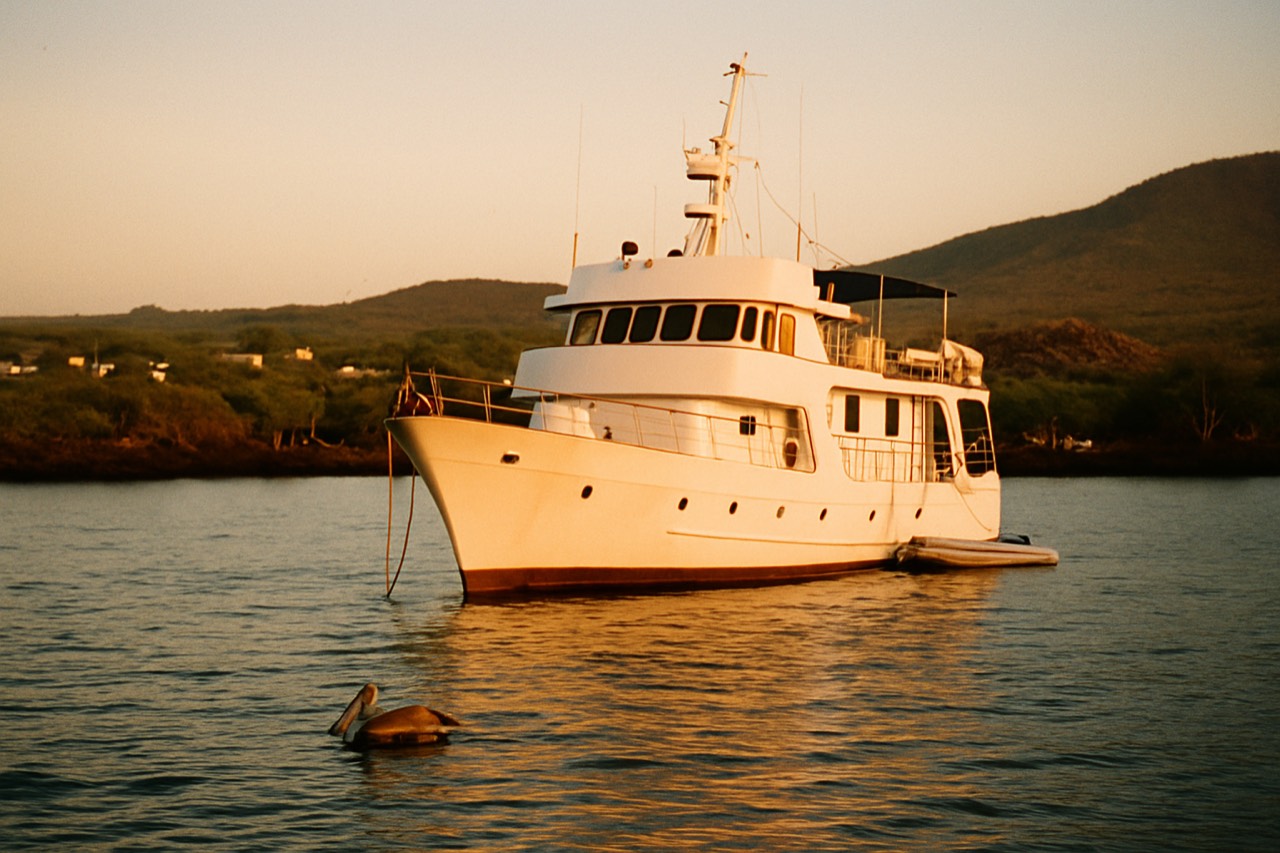
Short answer
A Galapagos travel agency sits in a chain that runs from the boat owner through a local operator to resellers, and each link adds margin. The same cabin can carry four prices in one afternoon because resellers set their own markup. Prices on this roster run from $450 to $8,066 per person, and the $200 park fee and $20 transit card are extra on most packages.
The same Galapagos cabin, on the same ship, on the same week, can show four different prices in a single afternoon of searching. That is not a glitch. It is the structure of the market: a chain that runs from the boat owner through a local operator to whichever reseller you happen to be looking at, with each link taking a margin. Understanding that chain is the single most useful thing a Galapagos buyer can do before paying anyone anything, and it takes about ten minutes to learn.
This site, Galapagos Islands Tour Packages, exists to make that chain visible. Below is how it works, where the money goes, and what to ask before you commit.
What Does A Galapagos Travel Agency Actually Do?
A Galapagos travel agency does not own boats or hotels. It assembles a permitted product from other people's inventory: cabin space from a vessel operator, hotel nights, transfers, guides and day excursions, bundled into one bookable package. The agency's real work is regulatory and logistical, because Galapagos tourism is built on park permits, fixed itineraries and mandatory licensed guides, none of which a visitor can arrange alone at most sites.
The chain has three broad layers. At the top sits the inventory owner: the family or company that owns the yacht, catamaran or hotel. Below them sits the local operator, an Ecuadorian company that holds the park permits, employs the naturalist guides and packages the product. Below that sit resellers, agencies outside Ecuador that sell the operator's product at their own marked-up price. Some agencies occupy two layers at once. A few occupy all three.
The layer matters because it explains what you are actually paying for. Book with the owner and you buy inventory. Book with a reseller and you buy inventory plus a markup plus, sometimes, genuine service: someone who answers the phone in your timezone, holds your documents and sorts out a problem when a flight changes. The honest framing is that a good reseller earns their margin in service, and a bad one earns it in opacity.
It also explains why agencies cannot invent products. A cruise itinerary in Galapagos is fixed by park resolution: the operator's approved day-by-day plan "cannot be modified under any concept" without express park authorization, in the words of a real DPNG itinerary resolution. No agency, however creative, can swap your Tuesday landing site. What differs between sellers of the same cabin is price, service and what is bundled around it.
Who Sells The Same Cabin, And Where Does The Margin Sit?
Every seller of a given Galapagos cabin is working from the same wholesale price set by the vessel operator. The operator's own price is the floor. Direct agencies add a service margin, typically the smallest markup. Distant resellers add more, because they pay for marketing, foreign staff and commissions. The spread between the floor and the highest reseller price is the money you can save by comparing before booking.
The practical arithmetic is simple. An operator releases a cabin at a wholesale rate. Each seller prices it independently. One may bundle flights, another may not; one may include the park fee, another leaves it out. Because the base product is identical, a like-for-like comparison is possible, and it is the only comparison worth making. Our Galapagos package cost guide breaks the full budget down line by line.
| Layer of the chain | Who they are | What they add | Where the margin sits |
|---|---|---|---|
| Inventory owner | Vessel or hotel owner | The bed itself | Wholesale rate to the operator |
| Local operator | Ecuadorian permit holder | Permits, guides, itinerary, logistics | Sets the retail floor |
| Direct-selling agency | Works closely with the operator | Bundling, transfers, booking service | Small markup on the floor |
| Distant reseller | Foreign seller of the same product | Marketing, local-language service | The widest spread, and the most savable |
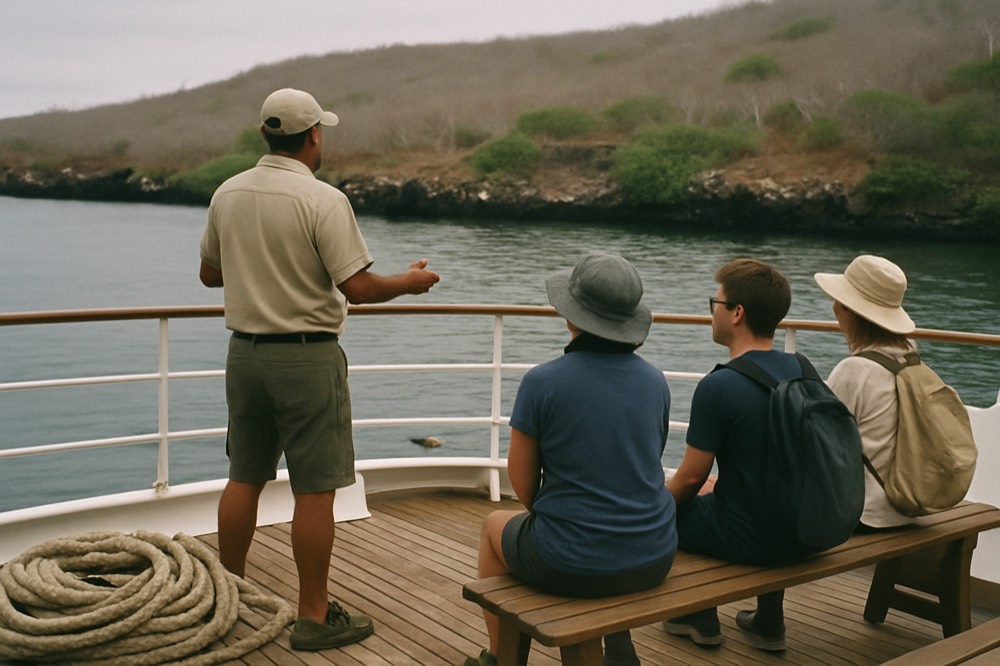
Three packages on this site show the range of what the same money buys at different layers. A private cruise sits at the top of the structure, a seven-day small-ship journey in the middle, and a short land-based package at the entry end.
One more layer deserves a name: the last-minute counter in Puerto Ayora. Travellers report that walk-in deals exist but are risky on dates and itineraries, and budget cruises found that way can end up costing what a land-based package costs once ferries, day tours and meals are added. The counter is a real option for the flexible, not a strategy for anyone with fixed dates.
Why Does The Same Cabin Show Four Prices In One Afternoon?
The four prices exist because four independent sellers set four independent markups on one wholesale rate, and because each bundles different extras. One price includes flights, one does not. One includes the park fee, one leaves it as a surprise at the airport. Comparing headline prices without normalizing for inclusions is the single most expensive mistake in Galapagos booking, and it is entirely avoidable.
The extras that move a headline price are predictable. Flights from Quito or Guayaquil are a real cost that some packages fold in, and the $200 park fee plus the $20 transit card sit outside most packages. When a listing does not state whether something is included, treat that as "not stated", not as "included", and ask. Our flights, park fee and transit card guide covers exactly what those extras cost and how each is paid.
The park fee itself is paid in cash, US dollars, to rangers on arrival at Baltra or San Cristobal, and no official online prepayment portal exists, per the park's own fee page. The transit card is bought at the CGREG counter at Quito or Guayaquil airport, with free online pre-registration available to speed it up, per the official CGREG FAQ. A seller who tells you they will "prepay your park fee online" is describing something the official system does not offer.
What Should You Ask Before Paying A Deposit?
Ask five questions before any deposit: which company holds the park permit, exactly which meals and transfers are included, whether flights and the park fee are in or out, what the cancellation terms are in writing, and whether the cabin is confirmed or on request. The answers separate a transparent seller from one renting you a screenshot. A seller who answers all five quickly is operating at the honest end of the chain.
The permit question matters more than it sounds. The entity holding the permit is the one bound by the park's fixed itinerary rules, and only vessels under 20 passengers may change itinerary at all outside proven force majeure, per the park management plan. If a seller cannot name the operator, they are a reseller of a reseller, and your recourse in a problem shrinks with every layer.
| Question to ask | A good answer | A warning sign |
|---|---|---|
| Who holds the park permit? | A named Ecuadorian operator | "Our local partner", unnamed |
| Are flights included? | A clear yes or no, with the route | Vague "assistance with flights" |
| Is the park fee included? | Yes, or a clear no plus the $200 figure | Silence, or "small local taxes" |
| Cancellation terms? | Written policy with dates and percentages | "Very flexible", verbal only |
| Cabin status? | Confirmed, with a cabin number or category | "On request", after you pay |
The intensive five-day, three-island package on this roster is a good example of a listing that states its boundaries plainly: it excludes the Galapagos flight in its own title, which is the honest way to sell, and it carries 4.7 across 56 reviews, the largest review pool on the roster.
What Does The Listed Price Actually Include?
On this roster, listed prices are per person and run from $450 to $8,066, but the headline almost never covers the whole trip. Most packages include breakfast and lunch, some include dinner, a few include flights, and the $200 park fee plus the $20 transit card sit outside nearly all of them. On 33 of the 50 products tracked here, the listing simply does not say whether the park fee is included, which means "not stated", not "not included".
Read every listing the same way: start from the per-person price, then subtract what is stated as included and price the rest yourself. Meals are the biggest variable after flights. A package with all meals included can cost more upfront and less in total than a cheaper one that leaves you buying dinner in Puerto Ayora for a week.
| Extra | Typical treatment on a package | Budget to hold |
|---|---|---|
| Flights, mainland to islands | Included on a few, excluded on most | Check the listing |
| Park entrance fee | Extra on most, not stated on many | $200 per adult, cash on arrival |
| Transit control card | Extra, bought at the mainland airport | $20 per person |
| Meals | Breakfast and lunch common, dinner varies | Check the listing |
| Wetsuit and snorkel rental | Sometimes "optional" but effectively needed | Ask before departure |
| Tips for crew and guide | Never included | Budget separately |
Traveller reports consistently flag the same hidden extras: wetsuit rentals described as optional but effectively required, drinks, Wi-Fi, and the inter-island ferries on land-based trips. None of these are large alone. Together they are the gap between the price you researched and the trip you paid for.
When Should You Book A Galapagos Package?
Book a cruise cabin three to six months ahead for the March-to-April foreign peak, and earlier for the small ships, because a cruise permit carries at most 16 passengers and a vessel at most 64, so small-ship inventory is structurally scarce. September is the annual demand trough and the coolest sea month at 21.5 degrees Celsius, the buyer's best window. Land-based packages can be booked later, since hotel beds are less scarce than permits.
The scarcity is legal, not marketing. The park caps a cruise permit at 16 passengers and a cruise vessel at 64, per the special tourism regulation in force since 2016, and itineraries are fixed by resolution. A 20-guest ship cannot add berths for March. When a seller says a cabin is the last one, on a small ship they are sometimes telling the truth.
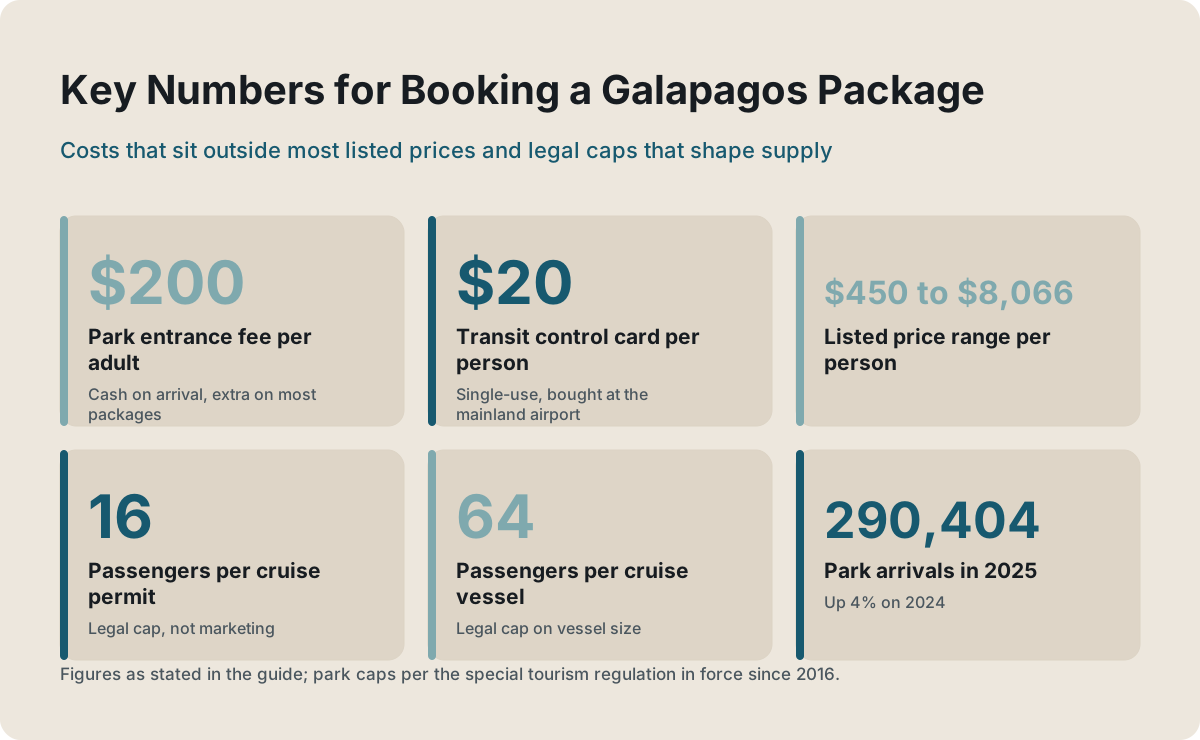
Demand data backs the calendar. The park counted 290,404 arrivals in 2025, up 4% on 2024, with the foreign peak in March to April, the Ecuadorian peak in August and the annual trough in September. The first half of 2026 ran 9% ahead of the same period in 2025, so the peaks are getting tighter, not looser. Our best time for a Galapagos cruise guide works through the wildlife side of that calendar.
The seven-day island-hopping package below is a useful contrast case: private, with free cancellation, and priced from $1,650 per person. Free cancellation changes the timing calculus entirely, because you can lock a date early and still walk away.
What Cancellation And Flexibility Terms Should You Expect?
Expect a written cancellation ladder: full refund or low penalty far out, rising penalties inside 30 to 60 days, and little or no refund inside two weeks, because the operator must still pay the boat. On this roster, several packages carry explicit free cancellation, including a four-day bay tour, a private seven-day hop and a highlights tour with flights included. Free cancellation is worth real money in a market where inventory is permit-limited.
Read the ladder, not the word "flexible". The questions that matter are the deadline for a full or partial refund, whether the deposit is refundable at all, and what happens to the operator's own force majeure clause. Travel insurance with trip cancellation cover is a separate decision, and it is cheaper bought the day you book than the week you fly.
One Galapagos-specific wrinkle: the transit card is single-use. If you cancel and rebook later, the pre-registration does not carry over, the CGREG system requires a new one. It is a $20 item, but it is the kind of small print that tells you whether you understood the terms you agreed to.
What Does A Booking Checklist Look Like Before You Pay?
A complete pre-payment checklist has six items: the operator named and the permit confirmed, the cabin or hotel category in writing, every inclusion and exclusion listed, the cancellation ladder in writing, the flights and fee budget priced separately, and the payment method protected by a card chargeback or a written invoice. Tick all six and you have removed almost every way this purchase goes wrong.
| Checklist item | Why it matters | Where to verify |
|---|---|---|
| Named operator with the permit | Fixes accountability and the real itinerary | Booking confirmation |
| Cabin or room category in writing | "Standard" means nothing unnamed | Confirmation email |
| Inclusions and exclusions listed | The $200 fee and flights move the total | The live listing |
| Cancellation ladder in writing | Verbal flexibility is worth nothing | Terms at checkout |
| Flights and fees budgeted | The extras are predictable, so price them | This site's cost guide |
| Protected payment method | Chargeback is your real recourse | Card or invoice |
Pay by card where the option exists, and keep the confirmation as a document, not a screenshot of a chat. Traveller forums carry recurring warnings about Quito-based agents who took deposits and became unreachable, and the consistent advice is to book where a paper trail and a payment instrument exist. That advice costs nothing to follow.
What Are The Red Flags In A Galapagos Booking?
The reliable red flags are an unnamed operator, a price far below every other seller of the same cabin, pressure to pay by bank transfer, a verbal-only cancellation policy, and any promise to prepay the park fee online, which no official system permits. Any one of these is a reason to slow down. Two together are a reason to walk away and compare elsewhere.
The too-cheap price deserves its own sentence. Because every seller works from the same wholesale rate, a headline dramatically below the field usually means something was removed: the flights, the transfers, a night, or the operator's solvency. Ask what changed, and if the answer is nothing, ask again.
The QR reservation rule is new enough that some sellers have not caught up. Six sites, including the Fausto Llerena tortoise centre on Santa Cruz and Las Grietas, now require an advance slot booked through a Galapagos-registered agency, issued as a single non-transferable QR code checked at the entrance. A package that includes those sites without explaining the reservation mechanic is a package that has not read the current rules.
Before the final questions, one comparison worth making: the three packages below span the whole price and format range of this roster, from a $450 short bay tour to an $8,066 seven-day cruise, which is the practical spread of what the same booking chain sells.
Common Questions About Booking A Galapagos Package
Do I Need A Travel Agency To Visit The Galapagos?
For most of the national park, effectively yes. Current park rules require visits to protected sites in the company of a DPNG-accredited naturalist guide, and cruise itineraries are fixed by park resolution. Independent travel is possible on the inhabited islands, but the signature sites are accessed through permitted tours.
Why Is The Same Galapagos Cabin Priced Differently Everywhere I Look?
Every seller of a cabin works from the same wholesale rate set by the operator, then adds its own margin and bundles its own extras. Flights, meals, transfers and the park fee move headline prices more than the cabin itself. Normalize for inclusions before comparing numbers.
Is It Cheaper To Book A Galapagos Package Last Minute In Puerto Ayora?
Sometimes, but it is a strategy for flexible travellers only. Walk-in deals exist, yet travellers report that dates and itineraries get risky, and once ferries, day tours and meals are added, a last-minute budget cruise can approach the cost of a pre-booked land-based package.
Should The Park Fee And Transit Card Be Included In My Package Price?
Usually not. The $200 park fee is paid in cash US dollars to rangers on arrival, and the $20 transit card is bought at the CGREG counter at Quito or Guayaquil airport. On many listings the inclusion is simply not stated, so ask, and budget both regardless.
How Far In Advance Should I Book?
Three to six months for a cruise in the March-April peak, earlier for ships under 20 guests, because permits cap a cruise vessel at 64 passengers and small-ship inventory cannot expand. September is the annual demand trough and the best buyer's window. Land-based packages tolerate later booking.
What Is The Safest Way To Pay A Galapagos Operator?
By card where possible, with a written confirmation that names the operator, the cabin category and the cancellation ladder. Keep the confirmation as a document. Chargeback rights and a paper trail are the practical protection in a cross-border purchase.